
Transforming Enterprise Knowledge Management with Applied GenAI
Introduction: The Crisis of Fragmented Intelligence
In the modern enterprise, knowledge is the most valuable—yet most poorly managed—asset. Despite decades of investment in document management systems,institutional truth remains trapped in fragmented silos such as ERPs, CRMs, and disparate messaging platforms. This fragmentation has given rise to a “search tax,” a systemic inefficiency where the active workforce spends a significant portion of their week navigatinglinks rather than deriving value from data.
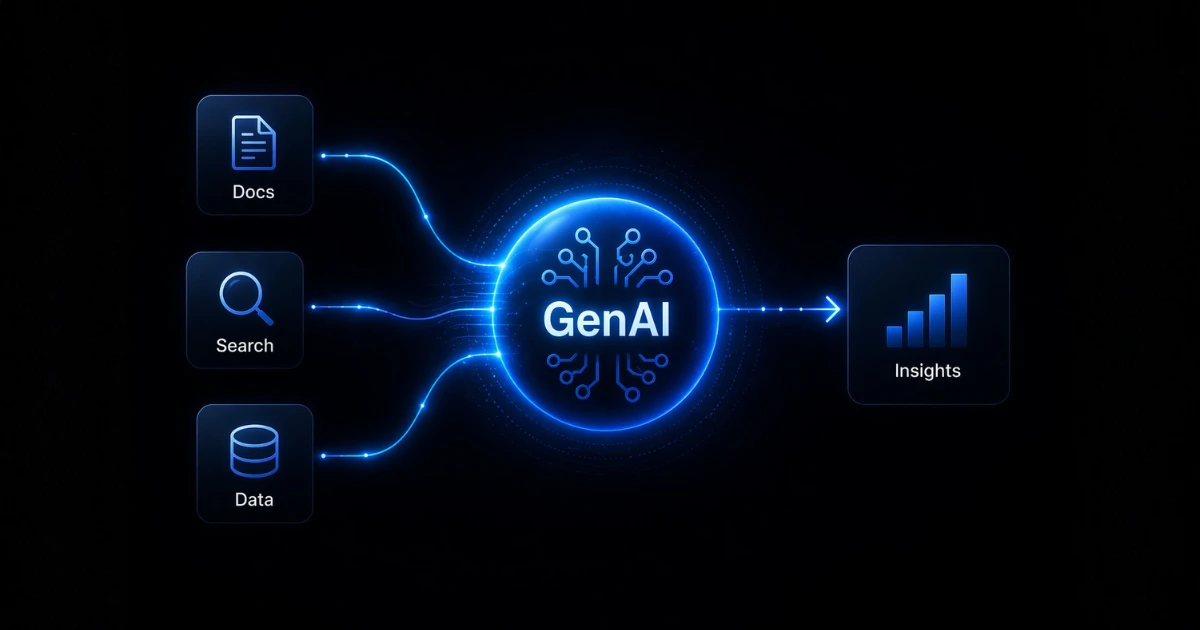
To remain competitive, organizations must undergo a fundamental transformation: From static, siloed document repositories → to dynamic, self-learning answer engines that synthesize institutional truth. This evolution defines the new standard for Enterprise GenAI Knowledge Management, shifting the focus from simply “finding” information to “synthesizing” actionable answers through a unified reasoning layer.
The Strategic Framework: The Cognitive Knowledge Nexus
1. Unify & Ingest
2. Vectorize & Embed
3. Contextualize
4. Synthesize
5. Govern & Learn
Measuring Success: The KPI Matrix
- Retrieval Latency: The average time elapsed from a user’s query to the delivery of an actionable answer. The target for high-performing systems is <2 seconds.
- Resolution Rate: This metric tracks the percentage of queries fully resolved by the AI engine without the need for human escalation. A high Resolution Rate indicates a robust synthesis and contextualization layer.
- Knowledge Freshness: In a fast-moving market, static data is obsolete data. This KPI measures the time lag between a document being updated in the source system and its availability in the GenAI answer engine.
- Employee Adoption: The ultimate measure of utility is the percentage of the active workforce using the system on a weekly basis. High Employee Adoption signifies that the “search tax” is being successfully dismantled.
Regional Insights: Navigating Global Complexity
United States: Speed and Onboarding
UK and European Union: Compliance and Clarity
Global Examples of Transformation
- Financial Services (US): A leading firm implemented the framework for automated compliance checking. By enabling loan officers to query policy documents directly, they achieved a 60% reduction in policy lookup time.
- Manufacturing (Germany): A manufacturer deployed a shop-floor maintenance assistant to navigate complex technical schematics. This resulted in a 40% reduction in machine downtime, as technicians could resolve issues using real-time, synthesized instructions rather than manual searching.
- Public Sector (UAE): A government entity launched a citizen service answer engine capable of handling regulatory queries with 95% accuracy in both Arabic and English, providing 24/7 availability and aligning with national digitization mandates.
Conclusion: Building the Self-Learning Enterprise
The shift from legacy document management to Enterprise GenAI Knowledge Management is no longer optional for organizations looking to scale. By adopting the Cognitive Knowledge Nexus, enterprises can eliminate the “search tax,” ensure data sovereignty across regions, and transform their fragmented silos into a unified, reasoning intelligence layer. This journey moves the organization away from static repositories and toward a future where institutional truth is synthesized, accessible, and self-updating.
Executive Summary
- The Problem of the “Search Tax”: Modern enterprises are hindered by fragmented data silos across SharePoint, Slack, and email, resulting in employees spending 20% of their time searching for information rather than executing tasks.
- The Strategic Shift: Leading organizations are transitioning from legacy “Search” (finding links) to “Answers” (synthesizing truth) by implementing a reasoning layer over proprietary data.
- The Cognitive Knowledge Nexus: This proprietary five-step framework—Unify, Vectorize, Contextualize, Synthesize, and Govern—provides a roadmap for building a self-updating intelligence engine.
- Quantifiable Outcomes: Implementation of Enterprise GenAI Knowledge Management targets specific performance metrics, including a Retrieval Latency of less than two seconds and significant increases in Resolution Rate.
- Global Compliance: Success requires balancing speed to market (US focus) with rigorous adherence to GDPR and the “Right to Explanation” (UK/EU focus) to ensure institutional trust.
Key Takeaways
Core Framework
The Cognitive Knowledge Nexus: Unify, Vectorize, Contextualize, Synthesize, Govern.
Primary KPI
Retrieval Latency target: <2 seconds from query to actionable answer.
Regional Priority
US: Speed to market; UK/EU: GDPR and data residency compliance.
Transformation
Moving from static, siloed document repositories to dynamic, self-learning answer engines.
FAQs: Enterprise GenAI Knowledge Management
1. How does this system integrate with our existing, fragmented data silos like SharePoint, Slack, and ERPs?
The first stage of the Cognitive Knowledge Nexus is Unify & Ingest. This process establishes a continuous data pipeline that connects disparate sources—including ERP, CRM, and internal document repositories—into a single reasoning layer. This eliminates the “search tax” by creating a unified intelligence engine rather than requiring a manual migration of your existing data.
2. How are security and AI hallucinations managed within the enterprise environment?
Security is addressed during the Contextualize stage by applying Role-Based Access Controls (RBAC) and domain-specific grounding to ensure users only access information relevant to their permissions. To mitigate hallucinations, the Govern & Learn stage implements specific hallucination guardrails and human-in-the-loop feedback loops, ensuring that the Synthesize stage only generates citation-backed answers that preserve institutional truth.
3. What is the primary metric for measuring the ROI of a GenAI-powered knowledge engine?
A critical measure of success is the Resolution Rate, which tracks the percentage of queries fully resolved by the AI without requiring human escalation. High resolution rates indicate that the system is successfully transforming from a tool that merely finds links into one that synthesizes actionable truth, directly recovering the 20% of time employees currently lose to inefficient information retrieval.
4. What are the performance benchmarks for system responsiveness and data accuracy?
Quantazone targets a Retrieval Latency of less than two seconds for the average time between a query and an actionable answer. Accuracy is maintained through the Vectorize & Embed process, which uses semantic vectors to capture deep meaning and intent rather than just keywords, paired with Knowledge Freshness monitoring to ensure the engine reflects the most recent document updates.
5. How does the framework accommodate regional regulatory requirements like GDPR?
Implementation is tailored to regional compliance needs. For the UK and EU, the system prioritizes GDPR compliance, data residency, and the “Right to Explanation” for all AI-generated answers. In the US, the focus remains on speed to market and reducing time-to-competence, while UAE implementations align with national digitization mandates and provide multi-lingual support.