

Enterprise AI Customer Lifecycle Intelligence Strategy

Enterprise AI 1

The current landscape of enterprise subscription models is increasingly volatile. Organizations are frequently bleeding revenue due to reactive churn management and the reliance on static, siloed customer data that inherently fails to predict user intent. To maintain a competitive edge, leadership must shift the strategic focus from traditional “Customer Management” to AI Customer Lifecycle Intelligence, creating a self-correcting, revenue-generating engine.

The Shift to Predictive Lifecycle Intelligence

The fundamental problem facing global enterprises today is the inability to act on customer data in real-time. Traditional CRM systems often serve as repositories of historical facts rather than engines for future growth. By adopting an AI Customer Lifecycle Intelligence strategy, organizations can move beyond these limitations, utilizing real-time behavioral foresight to maximize Net Revenue Retention (NRR). This transformation allows organizations to identify "predictive signals" —subtle indicators of customer dissatisfaction or growth potential—that are invisible to legacy systems. The goal is to create a seamless transition from reactive firefighting to a proactive growth posture.

The Canonical Framework for Enterprise Transformation

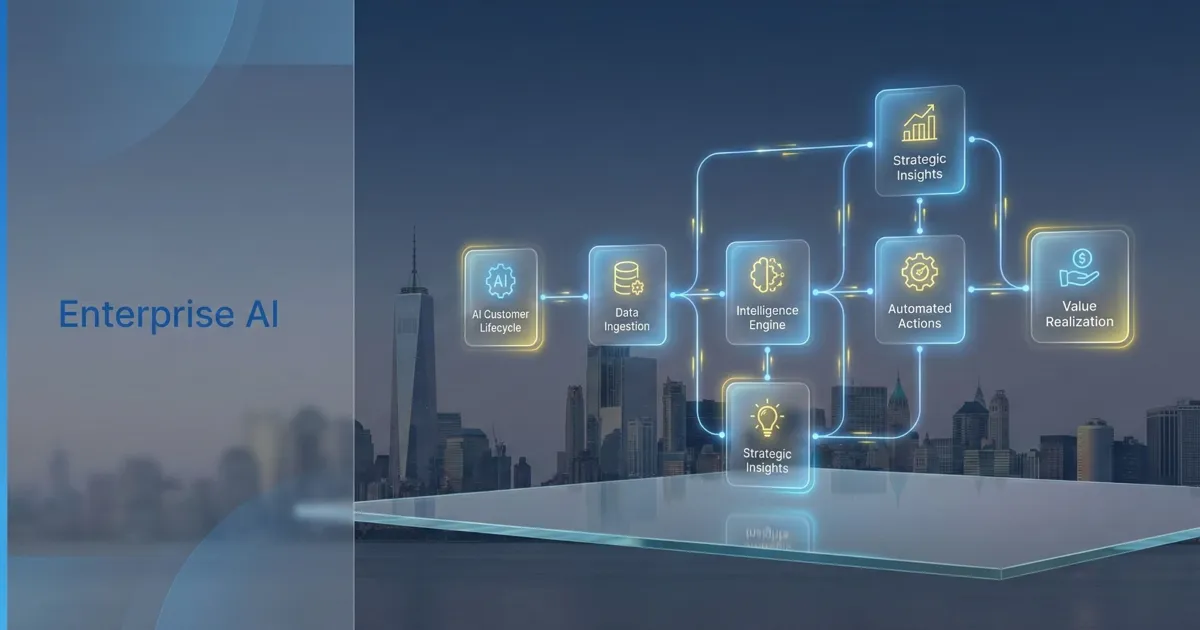
To successfully deploy AI Customer Lifecycle Intelligence, enterprises must adhere to a structured, four-step implementation process designed to ensure data integrity and scalable automation.

Step 1: Data Unification & Hygiene

The foundation of any intelligence strategy is the consolidation of fragmented touchpoints. In most large-scale organizations, critical data is trapped in silos across CRM platforms, product usage logs, and support ticketing systems.

Data Unification & Hygiene involves creating a single, clean source of truth. Without this foundational step, AI models risk producing “hallucinations” or inaccurate predictions based on incomplete datasets. In the US market, this step is particularly critical as organizations seek to move away from monolithic, inflexible legacy architectures toward more agile data environments.

Step 2: Predictive Signal Modeling

Once data is unified, the organization can deploy AI to identify non-linear patterns that indicate either a high risk of churn or a significant opportunity for expansion.

Predictive Signal Modeling goes beyond simple “red-yellow-green” health scores. It analyzes complex interactions across the customer journey to provide high KPI 2: Churn Prediction_Accuracy (%). By understanding the nuances of how a customer interacts with a product or service, the enterprise can predict value erosion before it manifests as a cancellation request. This capability is the heart of AI Customer Lifecycle Intelligence.

Step 3: Automated Intervention Orchestration

Insights are only valuable if they lead to action. The third step in the framework is Automated Intervention Orchestration, which involves triggering real-time, context-aware actions across multiple channels based on the scores generated in the modeling phase.

Whether it is an automated outreach for a training session, a customized expansion offer, or a proactive support intervention, these actions must be synchronized and contextually relevant.This precision leads directly to an improved KPI_ 3: Intervention Conversion Rate, ensuring that the resources deployed to save or grow an account are utilized effectively.

Step 4: Value Realization Loop

The final step is the creation of a Value Realization Loop. This involves measuring the specific economic impact of every intervention and feeding that outcome data back into the AI model.

This self-correcting mechanism ensures the system evolves. By analyzing which interventions led to a successful KPI_4: Customer Lifetime Value (CLTV) Uplift, the AI learns to refine its predictive capabilities and intervention triggers, creating a continuously improving revenue engine.

Quantifying Success: The KPI Matrix

For a Chief Revenue Officer (CRO) or Chief Marketing Officer (CMO), the success of an AI Customer Lifecycle Intelligence strategy must be grounded in hard metrics. The following KPI Matrix defines the standard for enterprise-grade performance:
  1. KPI_1: Net Revenue Retention (NRR) Impact: This is the primary measure of thestrategy’s ability to not only retain existing revenue but to grow it through predictive expansion.
  2. KPI_2: Churn Prediction Accuracy (%): Measures the precision of the AI in identifyingat-risk accounts before they churn.
  3. KPI_3: Intervention Conversion Rate: Evaluates the effectiveness of the automated actions triggered by the system.
  4. KPI_4: Customer Lifetime Value (CLTV) Uplift: Tracks the long-term economic value generated by moving from reactive to predictive management.

Regional Strategic Insights: The US Market

In the United States, the strategic focus for AI Customer Lifecycle Intelligence is distinct from other global regions. While European markets may prioritize "explainable AI" for GDPR compliance, and the APAC region focuses on mobile-first data ingestion, the US market is currently defined by a drive for extreme scalability.

Many North American enterprises are burdened by monolithic CRM suites that have become "systems of record" but lack the intelligence to be "systems of action. " The current opportunity in the US involves displacing these legacy suites with agile intelligence layers that can sit on top of existing data or replace outdated modules entirely. This allows US firms to maintain their scale while gaining the behavioral foresight necessary for modern competition.

Real-World Impact: North American SaaS Case Study

The effectiveness of this framework is best demonstrated through its application in high-growth environments. A prominent North American SaaS Platform recently implemented an AI Customer Lifecycle Intelligence strategy focused on automated expansion offers. By following the Canonical Framework—specifically focusing on Predictive Signal Modeling to identify users ready for upgrades—the organization achieved a 15% NRR uplift. This was not achieved through manual sales outreach, but through the Automated Intervention Orchestration of context-aware offers delivered at the moment of highest customer intent.

From Reactive to Predictive: The Transformation

The transition is best summarized by the strategic shift: “From static, reactive account management → to dynamic, predictive, and automated lifecycle intelligence”.

Enterprises that continue to rely on manual, reactive processes will find it increasingly difficult to compete with organizations that have automated their growth interventions at scale. By unifying data, modeling signals, orchestrating interventions, and closing the loop on value realization, the modern enterprise transforms its customer success department from a cost center into a self-correcting revenue engine.

Deploying an AI Customer Lifecycle Intelligence strategy is no longer a luxury for the “innovation” wing of the company; it is a core requirement for any organization seeking to stabilize and grow its subscription revenue in a volatile market.

To discuss how this framework can be applied to your specific enterprise architecture and to see how you can improve your KPI_1: Net Revenue Retention (NRR) Impact, the next step is astrategic consultation.

Executive Summary

  • Strategic Pivot: Modern enterprises must transition from static, reactive account management to dynamic, predictive, and automated lifecycle intelligence.
  • Revenue Protection: Reactive churn management is insufficient; organizations require real-time behavioral foresight to predict value erosion before it occurs.
  • The Framework: Implementation follows a four-step Canonical Framework: Data Unification & Hygiene, Predictive Signal Modeling, Automated Intervention Orchestration, and Value Realization Loop.
  • Measurable Outcomes: Strategy success is defined by specific metrics, including KPI_1: Net Revenue Retention (NRR) Impact and KPI4: Customer Lifetime Value (CLTV) Uplift.
  • US Market Specifics: For American enterprises, the priority lies in displacing legacy monolithic CRM suites with agile, scalable intelligence layers.

Key Takeaways

Predictive Intent

AI-driven models identify non-linear patterns indicating churn risk or expansion potential far earlier than manual reviews.

Automated Action

Moving beyond insights to execution through real-time, context-aware actions across all customer channels.

Continuous Optimization

A closed-loop system ensures that outcome data is fed back into the model to refine accuracy and economic impact.

FAQs : The Global AI Workforce

The strategy shifts organizations from reactive firefighting to predictive growth by identifying expansion opportunities and churn risks before they manifest. By following the four-step Canonical Framework, enterprises can realize significant outcomes, such as the 15% uplift in KPI_1: Net Revenue Retention (NRR) Impact seen in North American SaaS implementations.

Yes, the implementation begins with Step 1: Data Unification & Hygiene, which is specifically designed to consolidate fragmented touchpoints into a single source of truth. This foundational step allows US enterprises to displace legacy monolithic CRM suites with agile intelligence layers that are built for scale.

On the contrary, Step 3: Automated Intervention Orchestration triggers real-time, context-aware actions that are precisely mapped to individual user behaviors. This ensures that every outreach is relevant and timely, which directly improves KPI_3: Intervention Conversion Rate.

Accuracy is maintained through Step 4: Value Realization Loop, which measures the economic impact of every intervention and feeds that data back into the system. This creates a self-correcting engine that continuously optimizes KP_2: Churn Prediction Accuracy (%) and KPI_4: Customer Lifetime Value (CLTV) Uplift.

Traditional management is inherently reactive, relying on static data that fails to predict future user intent. Moving to AI Customer Lifecycle Intelligence provides the real-time behavioral foresight necessary to automate growth interventions and prevent value erosion at scale.