

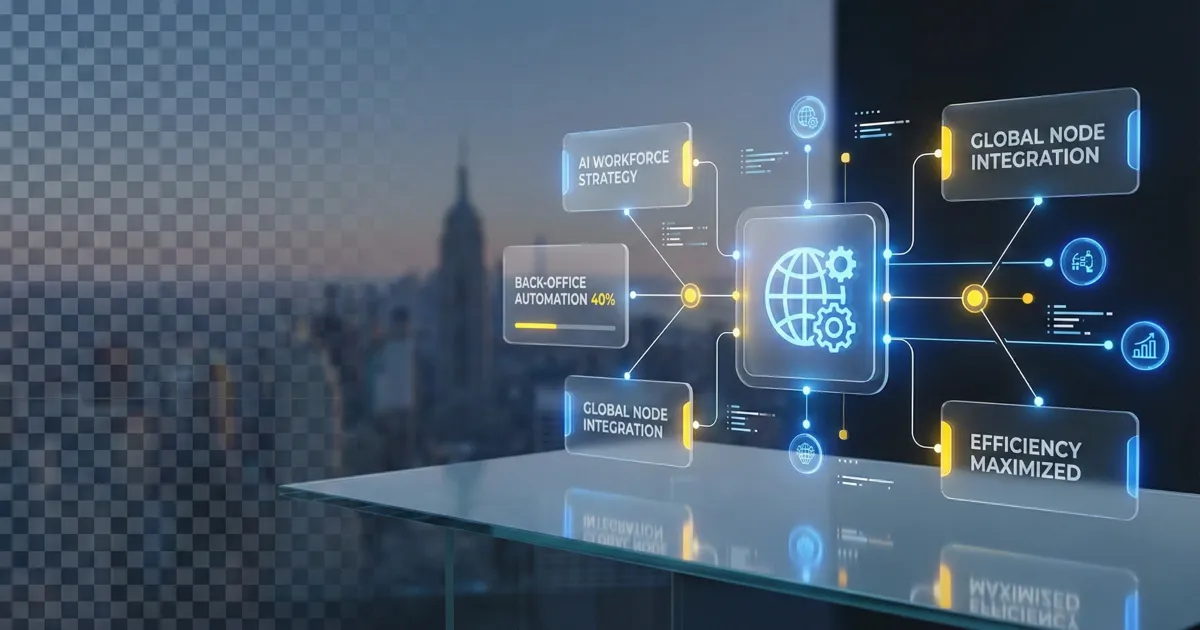
The current state of global enterprise operations is defined by a mounting crisis of “operational debt”. For decades, back-office functions—including invoicing, reconciliation, and compliance data entry—have relied on fragmented, manual, and serial processing. While Robotic Process Automation (RPA) provided a temporary bridge by automating specific tasks, it failed to address the underlying need for a cohesive, intelligent workforce capable of autonomous decision-making.
In the current economic climate, CTOs and COOs are seeking a more fundamental transformation through Enterprise AI Workforce Automation. This shift represents the move from “Task Automation” to an “Autonomous Workforce” powered by Agentic AI. Unlike traditional bots, these synthetic agents operate as a unified layer of intelligence, transforming the back office into a self-healing environment that scales instantly with demand.
The transformation from manual, fragmented, and serial processing to unified, autonomous, and parallel intelligent execution is no longer optional for global enterprises. As operational debt continues to stifle agility, the adoption of Enterprise AI Workforce Automation offers a clear path toward a more efficient and scalable future.
By following The Agentic Workforce Integration Model, organizations can systematically decompose their workflows, assign specialized agents, and establish the orchestration and governance necessary to reach a 40% Workflow Autonomy Rate by 2026. This transition not only secures a significant Operational Expense (OPEX) Reduction but also positions the enterprise to thrive in an increasingly automated global economy.
To begin your organization’s transition toward an autonomous back office, the next step is a strategic evaluation of your current workflow friction.
Automate 40% of back-office workflows by 2026.
Target a 25-35% Operational Expense (OPEX) Reduction.
Use The Agentic Workforce Integration Model for structured scaling.
US prioritizes speed-to-market; UK/EU prioritizes GDPR-compliant "Human-in-the-Loop" governance.
Transition from serial, manual processing to parallel, autonomous execution.
Traditional RPA focuses on brittle task automation, whereas a global AI workforce represents a transition to unified, autonomous, and parallel intelligent execution. By adopting The Agentic Workforce Integration Model, enterprises can move beyond simple bots to a self-healing infrastructure that targets a 40% Workflow Autonomy Rate by 2026.
This strategy is designed to clear “operational debt” by shifting human talent from high-volume, low-value tasks to strategic oversight roles. Under this model, humans move into the “Manager Layer,” focusing on complex escalations and high-level decision-making while agents handle repetitive processing.
Governance is strictly managed through Step 4 of The Agentic Workforce Integration Model, which implements real-time monitoring rails and “Human-in-the-Loop” oversight. This ensures all synthetic agents remain GDPR-compliant and maintain a Compliance Accuracy Rate of greater than 99.9%.
The core KPIs for this transformation include an Operational Expense (OPEX) Reduction of 25–35% and a Processing Velocity Improvement of 8x–12x. These metrics are achieved by replacing fragmented, serial manual work with specialized agents capable of parallel execution.
The process begins with “Step 1: Decompose & Map,” where high-friction workflows are broken down into discrete, agent-solvable units. This granular mapping ensures that Enterprise AI Workforce Automation is applied to the areas of highest impact without disrupting core business logic.